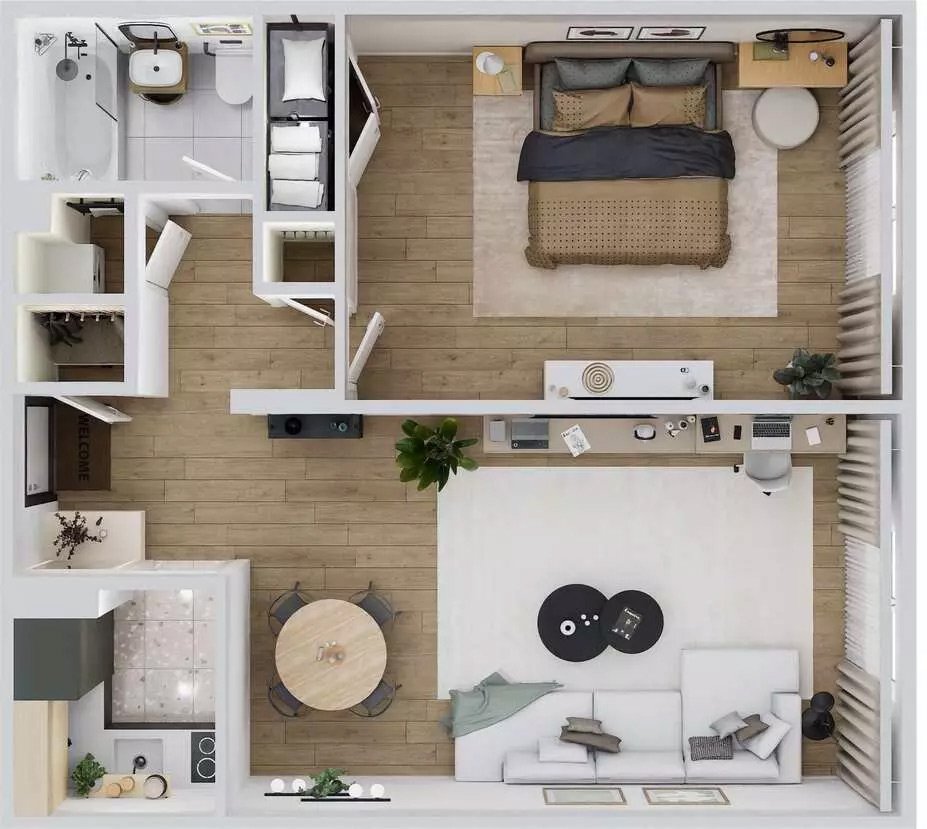
The design world is in the midst of a silent revolution, one where intuition meets algorithms, and the first sketches of a building no longer require hours bent over a drafting table. We're talking about AI floor plan generators, and understanding their profound AI Floor Plan Generator Use Cases & Applications is key to appreciating how they're rapidly transforming how we conceive and construct spaces.
These aren't just fancy drawing tools; they're intelligent design assistants, capable of translating complex requirements into optimized spatial arrangements with unprecedented speed and accuracy. From a homeowner dreaming of a new kitchen layout to a developer planning a sprawling residential complex, AI is reshaping the very foundations of design.
At a Glance: Why AI Floor Plan Generators Matter
- Speed: Generate complex layouts in minutes, not hours or days.
- Efficiency: Optimize space utilization by up to 30%, reducing waste.
- Accuracy: Adhere to building codes, accessibility standards, and user-defined constraints automatically.
- Exploration: Quickly iterate through countless design possibilities to find the ideal solution.
- Versatility: Applicable across residential, commercial, healthcare, educational, and retail sectors.
- Collaboration: Provides a tangible starting point for discussions between clients and designers.
The Blueprint for Tomorrow: What Exactly is an AI Floor Plan Generator?
At its core, an AI floor plan generator is sophisticated software that harnesses artificial intelligence and machine learning to automate and enhance the creation of floor plans. Think of it as a hyper-efficient, data-driven design partner.
Instead of an architect manually sketching out every wall and room, these tools analyze a rich tapestry of inputs: your desired dimensions, specific feature requirements (like "open-concept living"), existing architectural datasets, and even regulatory standards like building codes and accessibility guidelines. They then process this information at lightning speed, generating multiple optimized spatial arrangements, often presented with clear labels and even interactive 3D visualizations. This innovation is a significant factor in why the global market for AI in architecture is projected to reach an impressive $2.5 billion by 2025.
Beyond the Sketchpad: Core AI Floor Plan Generator Use Cases & Applications
The beauty of AI floor plan generators lies in their adaptability. They empower a diverse range of professionals and individuals to streamline their design processes, leading to better, faster, and more informed decisions.
Residential Design: Building Dream Homes, Faster
For homeowners, custom home builders, and renovation specialists, the traditional process of visualizing a new space can be daunting and time-consuming. AI generators drastically simplify this.
Imagine you're planning a home extension or a complete interior overhaul. You can input the existing footprint, desired number of bedrooms, specific room adjacencies (e.g., kitchen next to dining), and even preferences for natural light. The AI can then propose multiple layouts, showing how rooms flow, where windows could be placed to maximize sun exposure, and how different configurations impact overall livability. This allows homeowners to actively participate in the design process, exploring options they might not have considered and refining their vision before expensive construction even begins. It's about translating abstract ideas into concrete, actionable blueprints almost instantly.
Commercial & Retail Spaces: Optimized for Profit & Productivity
In the commercial world, every square foot counts. Office layouts need to foster collaboration and productivity, while retail spaces must guide customer flow to maximize sales. AI floor plan generators are indispensable here.
- Office Environments: Companies can input team sizes, departmental adjacencies, and requirements for meeting rooms, quiet zones, and break areas. The AI can then generate layouts that optimize traffic flow, reduce wasted space, and even suggest ergonomic workstation arrangements. This directly contributes to enhancing productivity and employee well-being.
- Retail Outlets: Retailers can test different store layouts to understand how customers will move through the space, where product displays will be most effective, and how to create an engaging shopping experience. By analyzing vast datasets of successful retail designs, AI can recommend optimal merchandising zones and circulation paths, potentially boosting sales and customer satisfaction.
- Hospitality: Hotels and restaurants can use these tools to design efficient kitchens, inviting dining areas, and comfortable guest rooms, all while adhering to strict operational requirements and aesthetic standards.
Real Estate Development: Scaling Vision & Speed
For real estate developers managing large-scale projects—from apartment complexes to mixed-use developments—time is money, and efficiency is paramount. AI floor plan generators are a game-changer for exploring multiple design options rapidly.
Developers can input the plot dimensions, zoning regulations, desired unit mix (e.g., number of 1-bed, 2-bed apartments), and shared amenity requirements. The AI can then generate hundreds of feasible layouts, complete with unit arrangements, common areas, and parking solutions. This allows developers to quickly assess project viability, compare different revenue-generating configurations, and identify the most cost-effective and appealing designs. The ability to reduce the time required to create initial floor plans by up to 80% is a powerful competitive advantage in a fast-paced market.
Interior Design: Where Aesthetics Meets Algorithm
Interior designers traditionally spend significant time drafting and redrafting layouts to find the perfect balance of function and aesthetics. AI tools augment this creative process.
Designers can leverage AI to quickly experiment with different furniture placements, color schemes (when integrated with rendering tools), and material choices within a generated floor plan. The AI can suggest layouts that optimize for natural light, traffic flow within a room, and the best arrangement of furniture to create a sense of spaciousness or intimacy. This frees designers to focus more on the artistic and client-facing aspects of their work, exploring a wider range of possibilities to create truly functional and aesthetically pleasing room layouts.
Specialized Facilities: Precision in Critical Environments
Certain building types, like healthcare and educational facilities, have highly specific and critical design requirements. AI floor plan generators ensure these needs are met with precision.
- Healthcare Facilities: Designing a hospital or clinic requires meticulous attention to patient flow, staff efficiency, infection control, and access to medical equipment. AI can generate efficient hospital and clinic layouts that optimize these critical factors, ensuring seamless operations and enhanced patient care. For instance, it can suggest ideal adjacencies for operating rooms, recovery areas, and patient wards, improving response times and reducing staff workload.
- Educational Facilities: Creating optimal learning environments involves considering classroom sizes, student circulation, access to natural light, and specialized areas like labs and libraries. AI can help design school layouts that promote collaborative learning, safety, and efficient use of space, adapting to modern pedagogical approaches.
Property Management & Facility Planning: Efficiency at Scale
Property managers oversee countless spaces, from residential units to commercial complexes. AI floor plan generators offer powerful tools for ongoing management and optimization.
They can be used to quickly document existing layouts, plan for future tenant improvements, or optimize common areas. For instance, a property manager could use AI to reconfigure a vacant office floor for a new tenant's specific needs in minutes, or to plan an efficient layout for a temporary event space. This improves responsiveness, reduces planning time, and helps in better space utilization over the long term.
Architects & Contractors: Augmenting Expertise
It's crucial to understand that AI floor plan generators are powerful complementary tools, not replacements for human architects or contractors. They streamline architectural design workflows, allowing professionals to focus on creative problem-solving and deep client needs.
Architects can use AI to rapidly generate initial conceptual designs, testing various configurations and spatial relationships before diving into detailed design. This saves immense time in the early ideation phase. Contractors can leverage these accurate plans for more precise bidding, improved logistics planning, and clearer communication with subcontractors. By automating the grunt work of generating initial layouts, professionals can dedicate more energy to innovation, complex problem-solving, and ensuring the project aligns perfectly with the client's vision and regulatory requirements.
Students & Enthusiasts: Learning & Exploring Design
For aspiring designers, architecture students, or even hobbyists, AI floor plan generators offer an accessible entry point into complex design principles.
These tools provide a low-barrier way to experiment with different layouts, understand spatial relationships, and visualize design concepts without needing extensive CAD software knowledge. It's a fantastic educational resource for understanding factors like traffic flow, functional zoning, and room adjacency constraints in a practical, hands-on way.
Under the Hood: How These Generators Work Their Magic
So, how do these intelligent systems turn raw data into functional floor plans? It's a fascinating blend of user input and algorithmic intelligence.
Users begin by providing key parameters:
- Total Area & Dimensions: The overall footprint of the space.
- Room Counts & Types: How many bedrooms, bathrooms, offices, etc.
- Adjacency Rules: "Kitchen must be next to dining," or "master bedroom should be secluded."
- Functional Zones: Defining areas for specific activities, like a "living zone" or "work zone."
With these inputs, the AI kicks into gear. It consults vast datasets of existing floor plans, building codes, and design best practices. It then applies algorithms to optimize various factors: - Traffic Flow: Ensuring smooth circulation paths through the space.
- Natural Light: Maximizing window placement for daylight penetration.
- Privacy & Seclusion: Strategically placing private areas away from high-traffic zones.
- Accessibility: Integrating ramps, wider doorways, and clear pathways where required.
- Sustainability: Potentially even considering building orientation for energy efficiency.
The output typically includes clearly labeled room layouts, often with options for 2D and 3D visualization, and crucially, they are usually exportable to standard formats like PDFs and DXF for seamless integration into traditional CAD/BIM software for further refinement.
Choosing Your Digital Architect: What to Look For in an AI Floor Plan Generator
With a growing number of tools on the market, selecting the right AI floor plan generator requires careful consideration. Here's what to evaluate:
- Precision and Efficiency: Does the generator adhere to industry standards, local building codes, and accessibility requirements? Accuracy is paramount, especially for professional use. How quickly can it generate options, and how robust are its algorithms in optimizing for complex constraints?
- Customization Options: Can you easily tweak the generated designs? Look for tools that allow for drag-and-drop modifications, material selection, and personalized styling. A good generator provides a strong starting point, but true value comes from the ability to tailor it precisely to your vision.
- User Interface and Experience (UI/UX): Is the software intuitive and easy to navigate? A clunky interface can negate the speed benefits. Look for clear visual feedback and a straightforward workflow. For those just starting or on a budget, exploring a Free AI floor plan generator can be a great way to test the waters and get a feel for different UIs before committing to a paid solution.
- Integration and Compatibility: How well does it play with other tools in your workflow? Support for exporting to DWG, DXF, and other common CAD/BIM formats is essential for professional integration.
- Cost and Support: What's the pricing model (subscription, one-time purchase)? Does it align with your budget? What kind of customer support is available, and how extensive are the learning resources?
- Sustainability and Accessibility Features: Can the tool consider factors like optimal building orientation for natural light and energy efficiency? Does it help design spaces that meet universal accessibility standards? These are increasingly important considerations for modern construction.
Addressing the Elephants in the Room: Common Questions & Misconceptions
Despite their growing popularity, AI floor plan generators still spark a few common questions and sometimes, misunderstandings.
Will AI Floor Plan Generators Replace Human Architects?
No, absolutely not. AI tools are designed to augment human expertise, not replace it. They handle the repetitive, data-intensive tasks of generating and optimizing initial layouts, freeing architects to focus on the higher-level creative problem-solving, client communication, aesthetic vision, and complex structural challenges that require nuanced human judgment. Think of them as incredibly powerful assistants, not substitutes.
How Accurate Are These Generators?
With proper inputs and a well-trained AI model, they can be remarkably accurate. They analyze vast datasets and can incorporate specific building codes and typical dimensions (like corridor widths or door swings) as "guardrails." However, human review is always essential to ensure the generated plan meets all specific project requirements and local regulations.
Can They Handle Complex or Unique Designs?
Yes, they are becoming increasingly sophisticated. While simpler rectangular spaces are easy, many advanced generators can handle irregular lot shapes, multi-story buildings, and a variety of complex constraints. For highly unique or avant-garde designs, the AI can still provide an excellent starting point, allowing designers to then add their distinct creative flair.
Are AI Floor Plan Generators Only for Professionals?
Definitely not. While professionals certainly benefit, the intuitive interfaces and rapid generation capabilities make them highly accessible to homeowners, small business owners, real estate agents, and even students. Anyone with a need to visualize or plan a space can find immense value in these tools.
The Future is Spatial: Embracing AI in Design Workflows
The landscape of architectural and interior design is undeniably evolving, with AI floor plan generators at the forefront of this transformation. They are not merely technological novelties; they are powerful enablers that streamline workflows, accelerate ideation, and foster greater collaboration.
By embracing these tools, professionals and individuals alike can explore a wider range of design possibilities quickly and efficiently, leading to more sustainable, cost-effective, and tailored building solutions. The true power lies in using AI to enhance human creativity and problem-solving, allowing us to build a better, more thoughtfully designed world, one optimized floor plan at a time. The next time you walk into an efficiently laid out office or a beautifully flowing home, remember the unseen algorithms that might have helped sketch its initial form.